What Is a Bostwick Consistometer and How to Use It
Posted: October 10, 2026
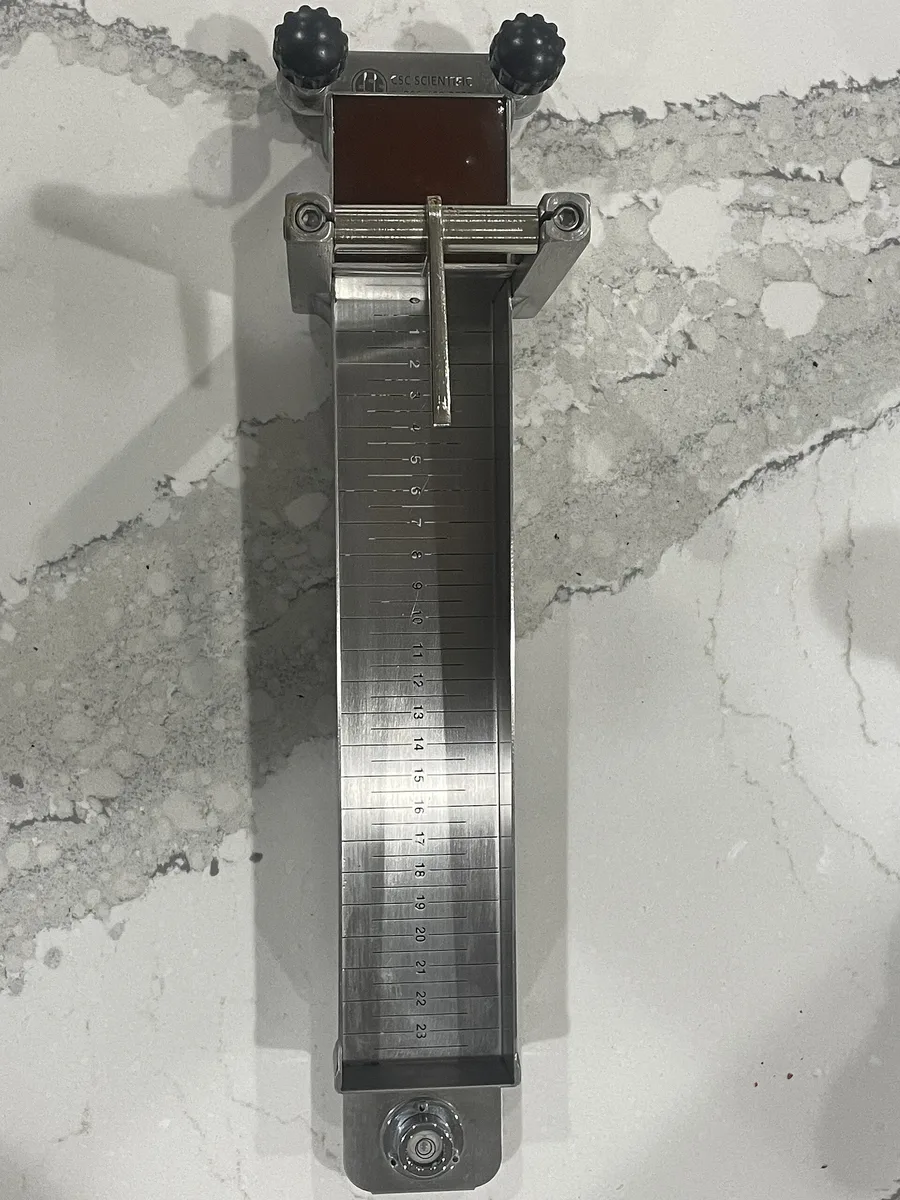
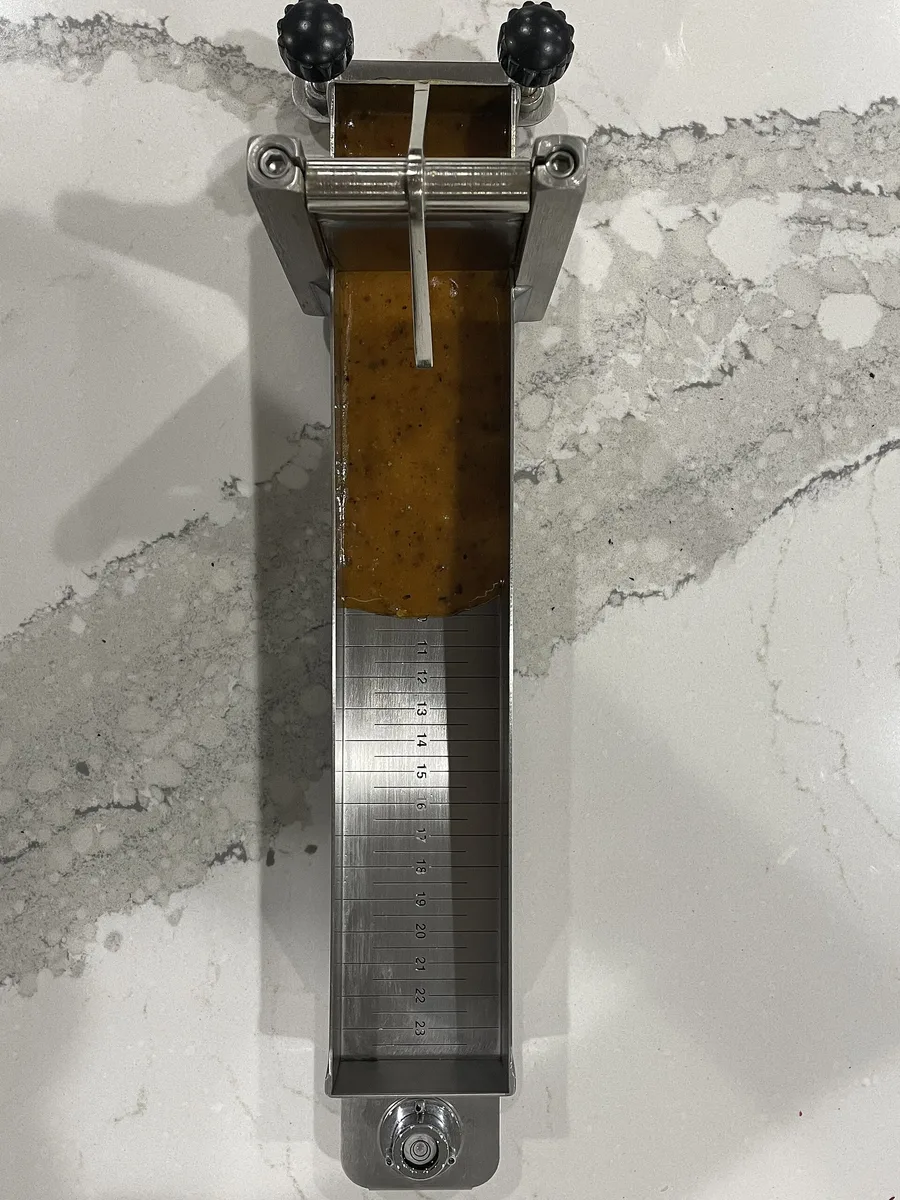
If you work in QC at a sauce, ketchup or baby food plant, you have probably heard someone say “it’s reading 7 on the Bostwick”. That number comes from one of the simplest instruments in a food lab. A Bostwick consistometer is a stainless steel trough with a spring gate at one end. You fill the space behind the gate with product, release it, and measure how far the product flows in 30 seconds. It’s simple to use, and still easy to get wrong in small ways that make results drift between operators and shifts.
Quick answer: A Bostwick consistometer measures how far a viscous food flows along a graduated stainless steel trough in 30 seconds after a spring gate is released. The result, in centimeters, is a fast batch-to-batch consistency check for ketchup, sauces, purees and baby food. The method is described in ASTM F1080.
What a Bostwick consistometer measures
The instrument measures consistency, which in practice means how readily a thick product flows under its own weight. The result is a distance in centimeters after a fixed time, usually 30 seconds. A higher number means a thinner product.
The reading is not viscosity. Flow along the trough depends on the product’s viscosity, its yield stress (the force needed to get it moving at all) and its density, all at once. You cannot convert a Bostwick value into centipoise, and two different products with the same Bostwick reading can behave quite differently in a pump or on a spoon. What the test does very well is compare batches of the same product against each other and against a target.
The method is standardized in ASTM F1080, and it is the consistency test written into the USDA grade standard for tomato ketchup. Most ketchup and tomato paste specifications worldwide quote a Bostwick range for the same reason.
Parts of the instrument
- A sample reservoir behind the gate, holding about 75 mL
- A spring-loaded gate with a trigger that lifts it instantly
- A trough, typically 24 cm long, with lines every 0.5 cm on the floor
- Two leveling screws and a spirit level
Everything is stainless steel, so it can be washed and used on the production floor as well as in the lab.
How to run the Bostwick test
- Level it. Put the consistometer on a solid bench and turn the leveling screws until the bubble is centered. Check it again every day, because benches get knocked.
- Get the sample to temperature. 20 °C is the usual reference, but follow your specification. Use a water bath if you can; a sample straight from a hot filler will read high.
- Fill the reservoir. With the gate closed, fill the reservoir slightly over the top, tap out any air pockets and scrape it level with a straight edge.
- Release and time. Press the trigger and start the stopwatch at the same instant.
- Read at 30 seconds. Note the furthest point the product has reached along the scale.
- Record and repeat. Write it down as “x cm / 30 s at 20 °C”. Clean and dry the trough, then run it again. Report the average of two or three runs.
Thick products like tomato paste usually won’t flow at all at full strength, so they are diluted with water to a set solids level (measured in °Brix with a refractometer) before testing. Whatever dilution you choose, it has to be the same every time, or the numbers can’t be compared.
Mistakes that make readings drift
When two operators get different numbers on the same batch, the cause is nearly always one of these:
- Temperature is the big one. Most sauces and purees get noticeably thinner as they warm up, so a sample a few degrees warmer than the last one will run further down the trough. If your lab isn’t temperature controlled, condition samples in a water bath.
- An unlevel trough. A slight tilt toward the end of the trough adds centimeters. A slight tilt back takes them away.
- Air bubbles in the sample reduce the amount of product in the reservoir and break up the flow front.
- Leftover water from cleaning thins the leading edge and makes it run further. Dry the trough completely between runs.
- Reading the wrong point. The flow front is often curved, running further down the middle than at the sides. Agree as a team which point you read (usually the furthest point) and write it into the SOP.
- Late timing: a two-second delay starting the stopwatch shows up in the result for runny products.
Setting a Bostwick specification
Unless a customer or a grade standard gives you a range, you will have to set your own. The practical way is to test batches that the business already considers good, both by eye and in customer feedback, and work out their typical range. Set your limits around that, then tighten them as you collect data.
Plotting results on a simple control chart, batch by batch, is worth the five minutes it takes. Slow drift in Bostwick values often shows up before anyone complains. It can point to a problem with raw materials, an evaporator running hot or a change in starch supplier.
Which products can you test?
Anything thick enough to hold together in the trough but fluid enough to move: ketchup, tomato paste and purees, barbecue and pasta sauces, mayonnaise and dressings, fruit purees, jams and pie fillings, baby food, custards and dairy desserts. Outside food, the same method is used for creams, lotions, paints and adhesives.
Very thin liquids such as juices and milk run straight to the end of the trough, so a Bostwick won’t tell you much about them. For those, and for any case where you need a true viscosity figure, a rotational viscometer is the better tool. We compare the two in Bostwick consistometer vs viscometer: which do you need?
Buying a Bostwick consistometer in the UAE
Frequently asked questions
How long does a Bostwick test take?
The flow time is 30 seconds. With leveling, filling and cleaning the trough, one test takes one to two minutes.
Why do Bostwick results vary between operators?
The usual causes are a trough that is not level, samples at different temperatures, air bubbles in the reservoir and reading the scale at slightly different times. Leveling before every test, fixing the sample temperature and using a timer removes most of the spread.
What is a good Bostwick reading for ketchup?
There is no single number. Each product has its own specification, set from batches that passed sensory and filling checks. The USDA grade standard for tomato ketchup uses the Bostwick test as part of grading, and most plants set tighter internal limits for their own recipe.
Hydra supplies stainless steel Bostwick consistometers to food manufacturers and testing laboratories across the UAE and the GCC. See the Bostwick consistometer product page for specifications, or contact our team on +971 4 591 1958 or sales@hydrauae.com for a quote.