A Bostwick consistometer tells you how thick a product is by letting it flow. Fill the reservoir, pull the trigger, and after 30 seconds read off how many centimeters the sample has run down the trough. It takes about a minute, needs no power, and the number means the same thing on the production floor as it does in the QC lab.
Food plants use it to check ketchup, tomato paste, sauces, fruit purees, jams and baby food batch by batch. Hydra supplies stainless steel Bostwick consistometers to food manufacturers and laboratories in Dubai, Abu Dhabi, Sharjah and across the GCC.
What is a Bostwick consistometer?
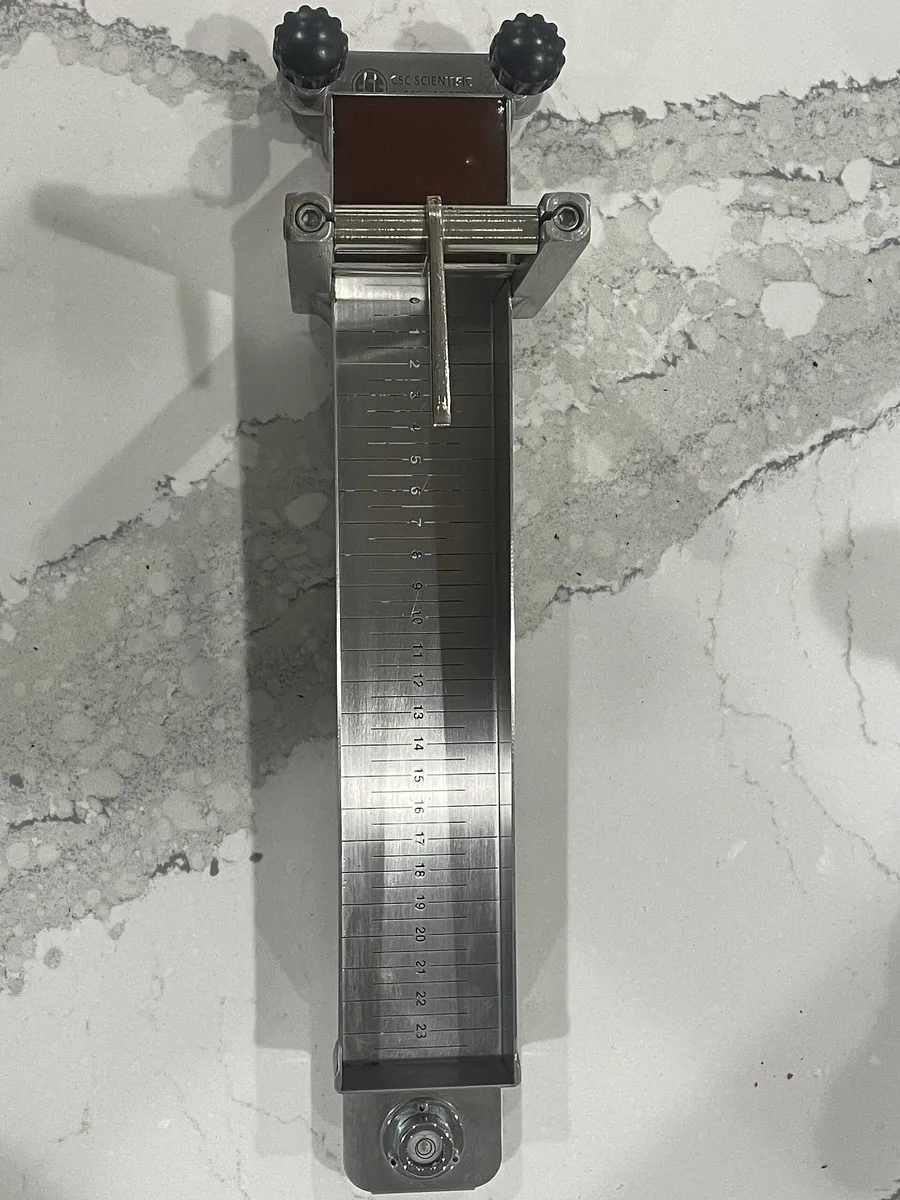
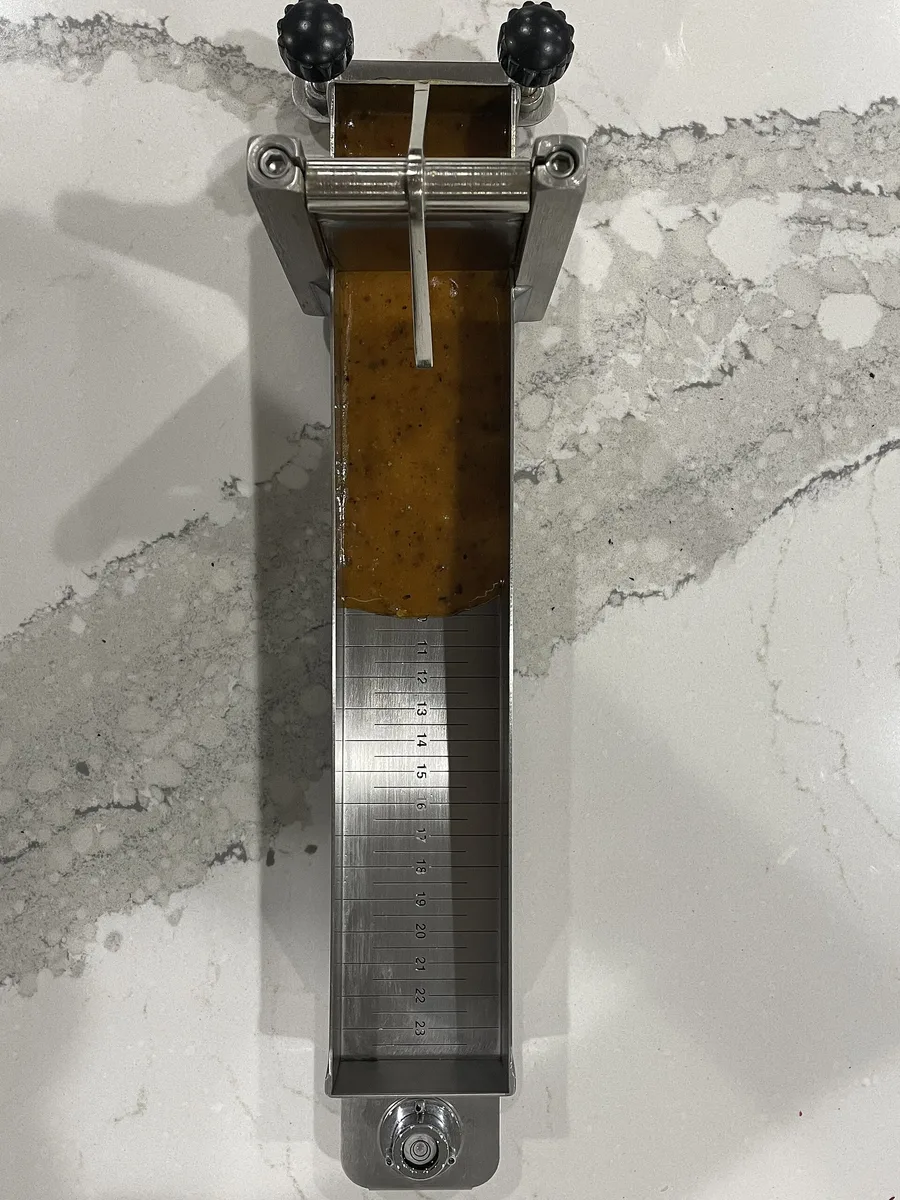
It is a rectangular stainless steel trough divided into two parts by a spring-loaded gate. The short section behind the gate holds the sample. The long section, usually 24 cm, has graduation lines every 0.5 cm along the bottom. When you release the gate, the product slumps out and flows down the trough under its own weight. Thin products travel further; thick ones barely move.
That distance, read after a fixed time, is the Bostwick value. It is a simple, empirical measurement, and that is the point. Two operators on two shifts can run the same test and get comparable numbers without any training in rheology. The method is described in ASTM F1080, and Bostwick flow is the consistency measure used in the USDA grade standard for tomato ketchup.
The reservoir and gate at the top of the trough. Photo: Awkwafaba, CC BY-SA 4.0
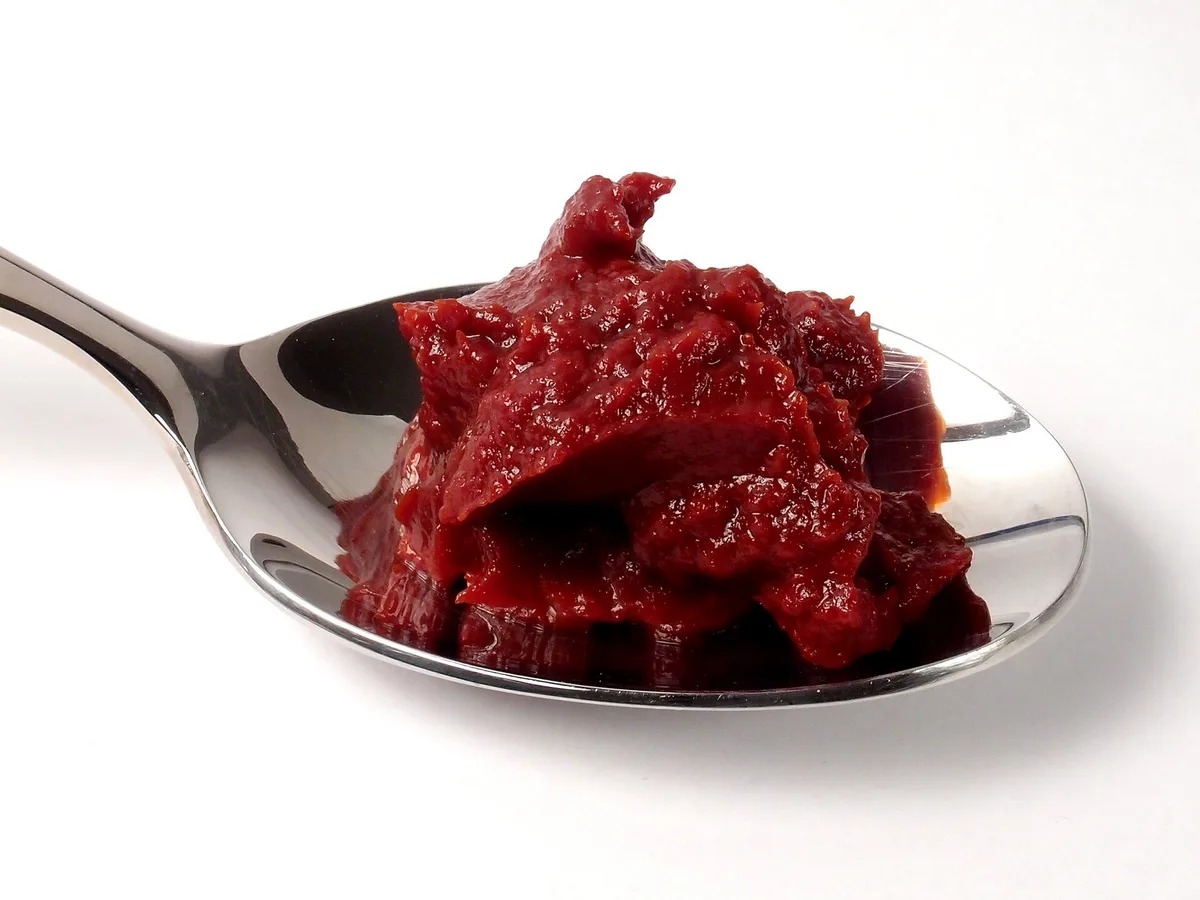
Tomato paste is one of the most common products tested. Photo: SKopp, CC BY-SA 3.0
How the Bostwick test works
Set the consistometer on a flat bench and adjust the two leveling screws until the bubble in the spirit level is centered. A trough that tilts even slightly will throw the reading off.
Bring the sample to the test temperature. 20 °C is common, but use whatever your product specification states. Temperature changes the result more than most people expect.
Close the gate, fill the reservoir (about 75 mL) and scrape the top flat with a straight edge. Remove trapped air bubbles before you level it.
Press the trigger to release the gate and start a stopwatch at the same moment.
After 30 seconds, read the furthest point the product has reached on the trough scale.
Record the result as centimeters in 30 seconds at the test temperature, for example "5.5 cm / 30 s at 20 °C". Clean the trough and repeat; most labs report the mean of two or three runs.
Some products, such as tomato paste, are too thick to flow at full strength. Plants usually dilute them to a fixed solids level (°Brix) before testing so that results stay comparable from one batch to the next. For the common mistakes that make readings drift between operators, see how to use a Bostwick consistometer.
Applications in food processing
A Bostwick consistometer is used wherever a product has to pour, spread or hold its shape in a predictable way:
Ketchup and tomato paste for grading and for checking concentration after evaporation
Sauces, dressings and mayonnaise, where a thin batch separates on the shelf and a thick one won't leave the bottle
Fruit and vegetable purees, jams and fillings before filling and after cooking
Baby food, where texture is part of the product promise and has to be the same in every jar
Dairy desserts, custards and puddings
Non-food products with similar flow behavior, such as creams, lotions, coatings and adhesives
A tomato processing line. Consistency checks at the end of evaporation stop off-spec paste moving to filling. Photo: Fahimeh Farrokhi / Tasnim, CC BY 4.0
Bostwick viscometer vs rotational viscometer
People often call the instrument a "Bostwick viscometer", but strictly speaking it doesn't measure viscosity. It measures how far a product flows under gravity, which depends on viscosity, yield stress and density all at once. There is no formula that turns a Bostwick reading into centipoise.
That is not a weakness for routine QC. If yesterday's batch read 6.0 cm and today's reads 8.5 cm, something has changed, and you know it in a minute. A rotational viscometer gives you absolute viscosity at a controlled shear rate, which is what you need for product development, for comparing different recipes, or for products that behave very differently when stirred. Many plants keep a Bostwick on the line and a rotational viscometer in the lab. Our guide to the Bostwick consistometer vs viscometer covers how to choose between them.
Bostwick consistometer
Rotational viscometer
What it reports
Flow distance (cm in 30 s)
Viscosity (mPa·s / cP)
Power needed
None
Yes
Time per test
About 1 minute
Several minutes
Operator skill
Minimal
Spindle and speed selection
Best for
Batch release, line checks, grading
R&D, specifications, non-Newtonian products
Technical specifications
Typical specifications for a standard 24 cm model. Confirm the exact figures for the model you order with our team.
Material
Stainless steel (316 food grade on most models)
Trough length
24 cm (30 cm versions available)
Graduations
0.5 cm divisions along the trough floor
Sample volume
Approx. 75 mL
Gate
Spring-loaded with trigger release
Leveling
Two leveling screws and built-in spirit level
Standard
ASTM F1080
Bostwick consistometer price in UAE
The price depends on the trough length, the steel grade and whether you need a calibration certificate with the unit. Send us your product type and the test method you follow, and we will quote the right model with delivery to your site in the UAE, Saudi Arabia, Qatar, Oman, Kuwait or Bahrain.
A Bostwick consistometer is a stainless steel trough with a gated reservoir at one end. You fill the reservoir with sample, release the gate and read how far the product flows along the graduated trough in a set time, usually 30 seconds. The result, in centimeters, is the Bostwick consistency of the product.
How do you measure Bostwick consistency?
Level the instrument with its leveling screws and spirit level, bring the sample to the test temperature (commonly 20 °C), fill the reservoir and scrape it flat, then release the gate and start a timer. After 30 seconds, read the furthest point the product has reached on the trough scale. Report the result as cm in 30 seconds at the test temperature.
What are the main parts of a Bostwick consistometer?
A sample reservoir, a spring-loaded gate with a trigger release, a trough graduated in 0.5 cm steps, two leveling screws and a spirit level. Standard units are made from stainless steel and have a 24 cm trough.
Is a Bostwick reading the same as viscosity?
No. The Bostwick test gives an empirical flow distance, not a viscosity in centipoise or mPa·s, and the two cannot be converted directly. It is a fast, repeatable check for comparing batches of the same product. For absolute viscosity at a defined shear rate you need a rotational viscometer.
How much does a Bostwick consistometer cost in the UAE?
Price depends on the trough length, the steel grade and whether you need calibration paperwork. Contact Hydra on +971 4 591 1958 or sales@hydrauae.com for a current quotation with delivery anywhere in the UAE and GCC.