Laboratory Fume Hoods: Types, Uses and How to Choose the Right One
Posted: November 3, 2026
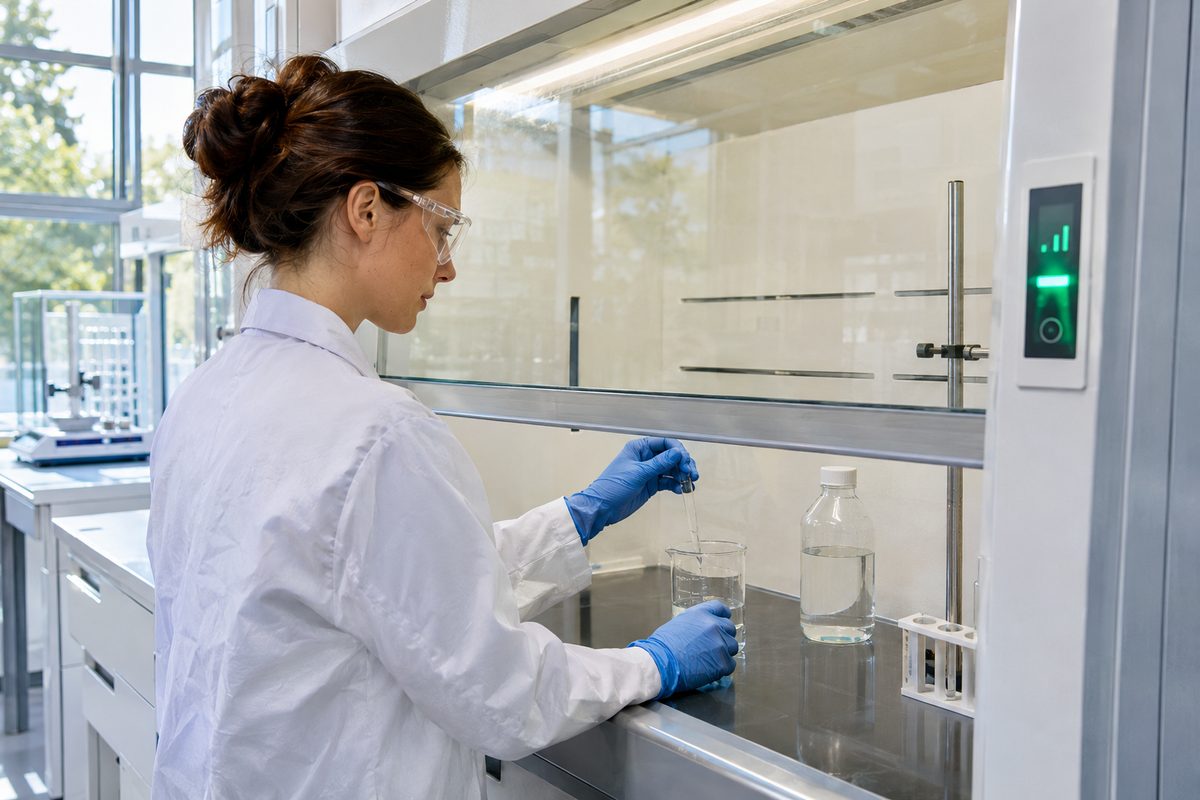
Every chemistry lab produces vapours you should never breathe — solvents, acid fumes, volatile reagents. A fume hood is the single piece of equipment that stands between those vapours and your team. It pulls contaminated air away from the user, dilutes it and either vents it outside or scrubs it through filters.
If you are planning a new laboratory in the UAE, upgrading an old installation or simply unsure whether you need a ducted or ductless unit, this guide covers what a fume hood does, the types available, how to judge whether one is working properly and what to check before you buy.
We supply and advise on laboratory fume hoods for industrial QC labs, universities, schools and testing facilities across Dubai, Abu Dhabi and Sharjah, so the points below reflect the questions UAE lab managers ask us most often.
What is a fume hood and what does it do?
A laboratory fume hood is a ventilated enclosure with an open front, a movable transparent sash and an exhaust system. Air is drawn in through the front opening, passes over the work surface and is pulled out through the top of the hood. Because air always moves inward, vapours generated inside the hood are carried away from the person standing in front of it.
A fume hood protects the user — not the sample. That distinction matters when people compare it with a biosafety cabinet or a laminar flow bench (covered below).
Typical fume hood uses in a laboratory include handling concentrated acids and bases, working with volatile organic solvents, digesting samples for metals analysis, heating reactions that release gases, and weighing or transferring toxic or odorous powders.
Types of laboratory fume hoods
Ducted fume hoods
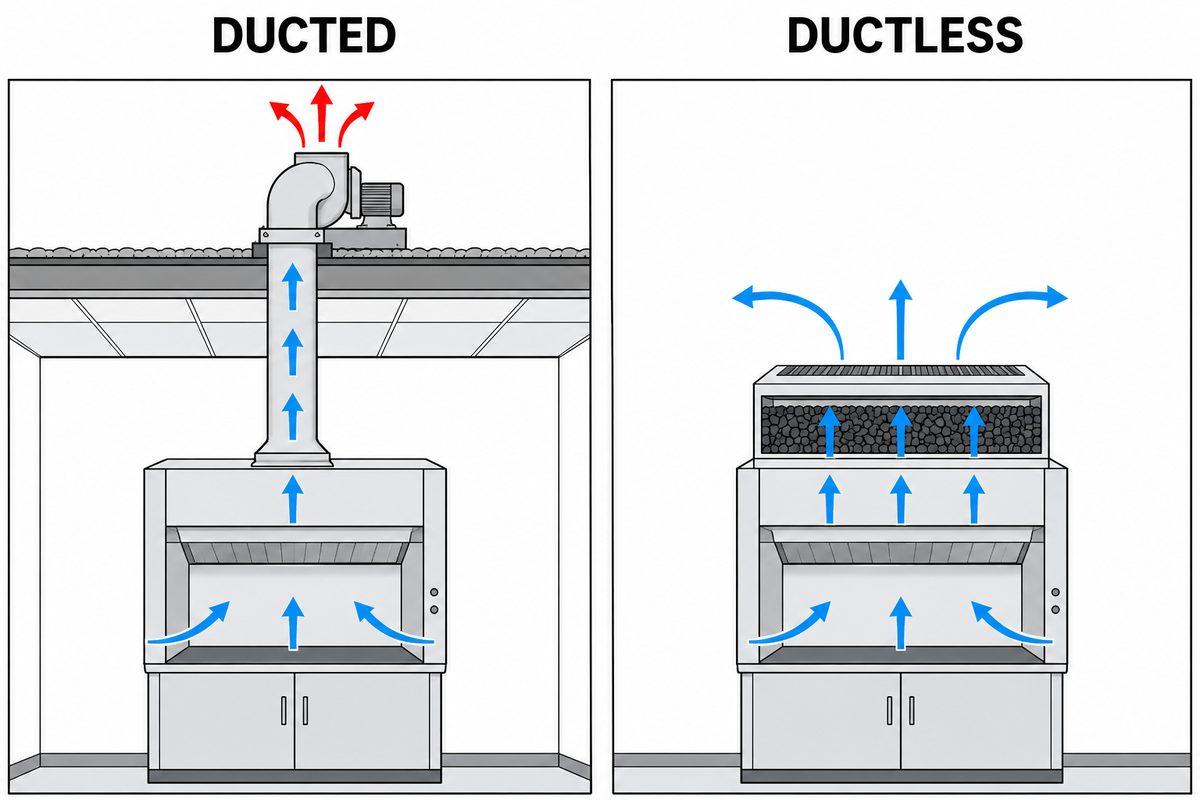
A ducted (or conventional) fume hood is connected to building ductwork and an exhaust fan that discharges air above the roof. It handles the widest range of chemicals, including high volumes of acid fumes and heavy solvent use, because nothing is captured inside the lab — everything is removed.
The trade-off is installation. You need a duct route, a roof exhaust, a make-up air supply and, in the UAE climate, careful coordination with the HVAC contractor: every cubic metre you exhaust is conditioned air that must be replaced and re-cooled. Ducted hoods suit permanent labs with heavy or varied chemical use.
Ductless (filtered) fume hoods
A ductless fume hood recirculates air through activated carbon or specialised chemical filters and returns it to the room. There is no ductwork, so it can be installed almost anywhere and moved later. Running costs are lower because you are not exhausting cooled air.
The limits are chemical. Filters are matched to specific chemical families, must be replaced on schedule and are not suitable for every application — high-volume acid digestion or large quantities of unknown solvents are better in a ducted unit. Ductless hoods are a strong fit for teaching labs, QC labs with a predictable chemical list and rented premises.
Benchtop and portable fume hoods
Smaller enclosures that sit on an existing bench. Most are ductless. They suit light, intermittent work — a single balance, a small titration station or occasional solvent handling.
Walk-in and specialised hoods
Walk-in hoods accommodate tall apparatus or trolleys. Perchloric acid hoods include wash-down systems to prevent explosive perchlorate build-up in the ductwork, and radioisotope hoods use stainless steel liners. Specify these only when the application demands it.
Fume hood vs biosafety cabinet vs laminar flow bench
These three look alike and are often confused. The difference is who or what each one protects.
- Fume hood — protects the user from chemical vapours. Air is exhausted or filtered; no HEPA filtration; not for biological agents.
- Biosafety cabinet (BSC) — protects the user, the sample and the environment from biological aerosols. Uses HEPA filters. A Class II BSC is the standard for microbiology and cell culture.
- Laminar flow bench (clean bench) — protects the sample only. HEPA-filtered air blows across the work and towards the user, so it must never be used with hazardous chemicals or pathogens.
If your work involves volatile chemicals, you need a fume hood. If it involves microorganisms, you need a biosafety cabinet. Using one in place of the other is a common and serious error.
How to tell if a fume hood is working: face velocity and sash position
A fume hood only protects you if air is moving inward fast enough. The measure is face velocity — the speed of air entering the open front. Most standards and lab safety guidance place the working range at roughly 0.4 to 0.5 m/s (80 to 100 feet per minute). Too slow and vapours escape; too fast and turbulence actually pulls fumes back out around the user’s body.
The sash sets the opening size and therefore the velocity. Work with the sash as low as practical — usually at or below the marked working height — and close it fully when the hood is not in use. Modern hoods include an airflow monitor that alarms when velocity drops; treat that alarm as a stop-work signal.
Have face velocity tested at installation and at least annually by a qualified technician, and keep the certificate. Performance test methods are defined in standards such as ASHRAE 110 and EN 14175, and reputable manufacturers test to one of these.
Safe working practices at a fume hood
- Keep your head outside the plane of the sash at all times.
- Work at least 15 cm inside the hood — equipment at the very front disrupts airflow.
- Raise bulky items on blocks so air can flow underneath them.
- Do not use the hood as a storage cabinet; cluttered hoods lose containment.
- Never block the rear baffle slots.
- Keep sources of ignition out of hoods used with flammable solvents.
- Lower the sash fully when you leave and at the end of the day.
A fume hood is engineering control; it works alongside, not instead of, personal protective equipment and the laboratory’s general safety rules.
How to choose a fume hood for your laboratory
- List the chemicals and volumes. This decides ducted vs ductless more than anything else. Heavy acid or large solvent use points to ducted.
- Check the building. Is a duct route to the roof possible? Can HVAC supply make-up air? In rented or heritage premises, ductless is often the only practical option.
- Size it. Standard widths are 1.2 m, 1.5 m and 1.8 m. Allow space for the largest apparatus you will use plus working room on either side.
- Specify the liner. Phenolic resin or polypropylene liners resist most acids and solvents; stainless steel for radioisotopes or perchloric acid.
- Insist on an airflow monitor and a sash stop. Both are inexpensive and directly affect safety.
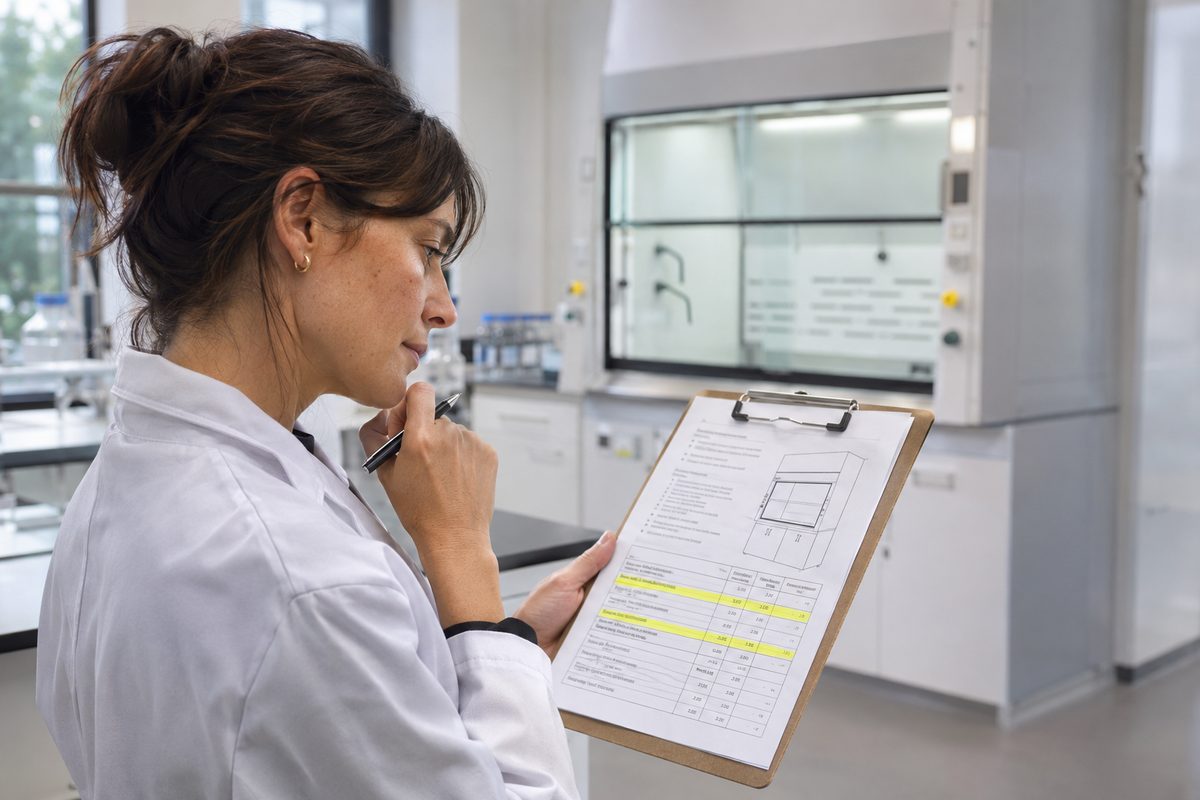
- Ask for test documentation. The hood should be tested to ASHRAE 110 or EN 14175 and commissioned on site with a face-velocity certificate.
- Plan for servicing. Ductless filters need replacing; ducted fans need maintenance. Choose a supplier who supports both.
Buying a fume hood in the UAE
The UAE climate makes energy use a real cost consideration. A ducted hood running continuously exhausts a large volume of cooled air every hour, so many labs here pair ducted units with variable-air-volume controls or choose ductless hoods where the chemical list allows it. Discuss this with your supplier before committing — the cheapest hood is rarely the cheapest to run.
Hydra Scientific & Chemicals Trading LLC supplies laboratory fume hoods, biosafety cabinets and laminar flow benches to laboratories across Dubai, Abu Dhabi, Sharjah and the wider Emirates, with installation support and face-velocity commissioning.
About the author
This guide was prepared by the technical team at Hydra Scientific & Chemicals Trading LLC, an ISO 9001:2015 certified supplier of laboratory equipment, instruments and safety products in the UAE. The team specifies and commissions ventilation and containment equipment for industrial QC, education and testing laboratories across the Emirates.
Frequently Asked Questions
What is a fume hood used for in a laboratory?
A fume hood protects the user from harmful vapours by drawing air inward and either exhausting it outside (ducted) or filtering it (ductless). It is used for handling acids, volatile solvents, toxic powders and any reaction that releases gases.
What is the difference between a ducted and a ductless fume hood?
A ducted hood vents air outside through building ductwork and handles the widest range of chemicals. A ductless hood filters air through carbon filters and returns it to the room — easier to install and cheaper to run, but limited to chemicals the filters are rated for.
What is the correct face velocity for a fume hood?
Most guidance places safe face velocity at about 0.4 to 0.5 m/s (80 to 100 fpm). Lower risks vapour escape; higher creates turbulence. Have it tested at installation and annually.
What is the difference between a fume hood and a biosafety cabinet?
A fume hood protects the user from chemical vapours and has no HEPA filtration. A biosafety cabinet uses HEPA filters to protect the user, the sample and the environment from biological aerosols. They are not interchangeable.
How often should a fume hood be tested?
Face velocity and containment should be tested at installation and at least once a year, with the certificate kept on file. Ductless filters are replaced on the manufacturer’s schedule or when saturation is detected.
Where can I buy a laboratory fume hood in the UAE?
Hydra Scientific supplies ducted and ductless fume hoods, biosafety cabinets and laminar flow benches across Dubai, Abu Dhabi and Sharjah, with installation and commissioning support.
Planning a new lab or replacing an old hood? Explore our fume hoods at hydrauae.com/products/fume-hood.php or contact our team for a fume hood specification and quote tailored to your chemical list and building.